MongoDB vs PostgreSQL: Choosing the Right Database for Your Project
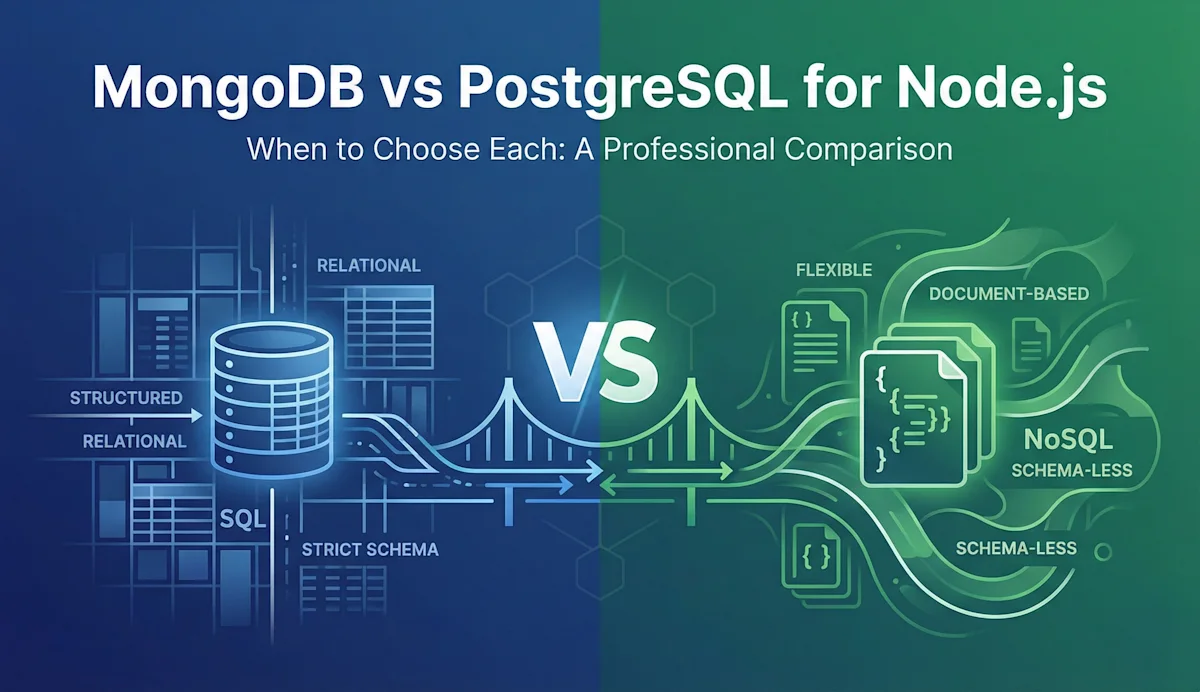
MongoDB vs PostgreSQL
With its different goals, MongoDB and PostgreSQL have very different performance profiles and application implications. These are the following:
PostgreSQL
PostgreSQL is a free and open source relational database management system (DBMS) that relies on whole tables and their attached schemas along with foreign keys to ensure data consistency.
Key Features
Complete compliance with ACID in transactions.
Protects data integrity through supervised schemas.
Uses SQL for managing complex searches and transaction control.
MongoDB
MongoDB, an open source document-oriented database using JSON-style BSON format to store data, it gives them flexibility in structure and supports various types of data.
Key Features
A schema can take any shape in order to accommodate diverse data types.
The data's horizontal scaling is orthogonal.
Allows developers to carry out full-stack Dropbox sync operations.
On the BASE model, it supports a powerful query language.
Database Structure
PostgreSQL needs a centralized schema, hence changeover has to be considered carefully.On the BASE model, it supports a powerful query language.ry different performance profiles and application implications. These are the following:
PostgreSQL is a free and open source relational database management system (DBMS) that relies on whole tables and their attached schemas along with foreign keys to ensure data consistency.
Key Features
Complete compliance with ACID in transactions.
Protects data integrity through supervised schemas.
Uses SQL for managing complex searches and transaction control.
MongoDB Structure
MongoDB, an open source document-oriented database using JSON-style BSON format to store data, it gives them flexibility in structure and supports various types of data.
Key Features
A schema can take any shape in order to accommodate diverse data types.
The data's horizontal scaling is orthogonal.
Allows developers to carry out full-stack Dropbox sync operations.
On the BASE model, it supports a powerful query language.
Database Structure Comparison
PostgreSQL needs a centralized schema, hence changeover has to be considered carefully. MongoDB can handle a mix of field types along with dynamic schemas.
Query Language
PostgreSQL uses SQL for robust queries, while MongoDB employs an aggregation pipeline.
Performance
PostgreSQL's strengths are comprehensive operating functions and strong transaction integrity. Its shortcomings include complex migration situations and an inability to scale out gracefully. On the other hand, MongoDB is able to scale up very well because it has native features for sharding. It is slow at doing large movements because of memory limits but has horizontal capacity for non-trivial queries where the result is many rows being returned at once.
Use Cases
PostgreSQL is ideal in a situation needing strong relations and the full ACID guarantee. MongoDB is especially good for documents, and it supports horizontal scale-out storage.
Cost
Both systems are open source and suitable for small applications but costs can rapidly grow at scale. MongoDB's Community version is free, but you still need additional storage space (and knowledge of distributed systems) to use it properly.
Migration
Moving from PostgreSQL to MongoDB means data denormalization, slowing down the conversion whereas the reverse run a risk of data being lost.
Hybrid Approaches
Many applications use both databases for different data needs.
Decision Making
Based on flexibility, ACID compliance, scalability, and data integrity
Conclusion
There is no one-size-fits-all database. Postgres is necessary for strict data consistency, but if one needs to scale out rapidly and support change in system requirements over time, MongoDB may well be the better choice. Depending upon how your data is structured and what your application expects of it, depends which way you should go.
Tom Nakamura
Writer at DevPulse covering Programming.